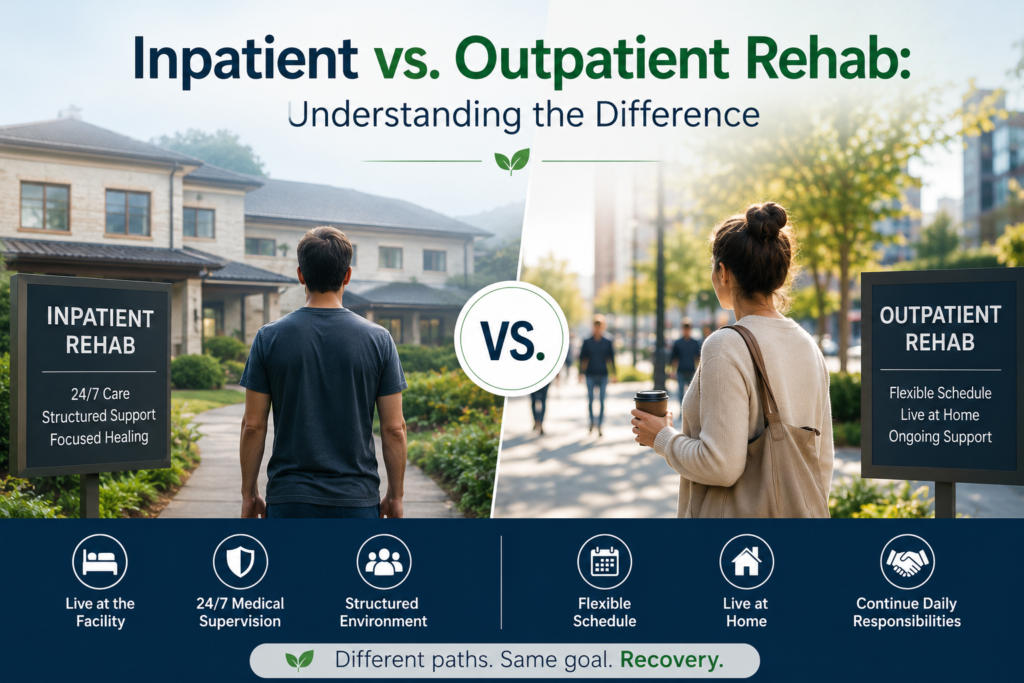
Choosing the right addiction treatment program is an important decision for individuals and families seeking recovery. Two common approaches are inpatient rehab and outpatient rehab. Although both aim to help individuals overcome addiction, they provide different levels of structure, supervision, and support.
Understanding the difference between inpatient and outpatient treatment can help families make informed decisions. The right program depends on several factors, including the severity of addiction, physical and mental health needs, home environment, family support, and professional recommendations.
Inpatient vs. outpatient rehab is not about deciding which treatment is always better. Instead, it is about identifying which level of care is most suitable for a person’s individual recovery needs.
What Is Inpatient Rehab?
Inpatient rehab is a structured treatment programme where individuals live at a rehabilitation facility for a specific period. During their stay, they receive professional care, counselling, medical support, and other recovery services according to their individual needs.
Living at a rehabilitation centre provides a controlled and supportive environment away from situations that may encourage addictive behaviour. Individuals can focus more fully on recovery without dealing with some of the daily distractions and triggers found in their usual surroundings.
Inpatient treatment may be particularly suitable for individuals who need a higher level of supervision or whose home environment may not provide adequate support for recovery.
At Aarogya Rehab, the organisation describes residential treatment, medical care, detoxification, counselling, psychological support, yoga, relapse prevention, and aftercare as components of its broader recovery approach. Aarogya Sewa Samiti aims to provide structured support for individuals working toward recovery from addiction.
What Is Outpatient Rehab?
Outpatient rehab provides addiction treatment without requiring the individual to live at a rehabilitation facility. The person continues living at home while attending scheduled counselling, therapy, medical appointments, or other treatment sessions.
This approach allows individuals to continue certain daily responsibilities while receiving professional support. Depending on the programme, appointments may take place several times a week or according to an individual’s treatment plan.
Outpatient treatment may be suitable for individuals who have a stable and supportive home environment and whose recovery needs do not require residential supervision.
However, the appropriate level of care should always be determined with guidance from qualified healthcare and addiction professionals.

“A realistic image of an adult successfully balancing work and recovery with support from a counsellor”
Inpatient vs. Outpatient Rehab: The Main Difference
The biggest difference between inpatient and outpatient rehab is where the individual receives treatment and how much structure and supervision are provided.
In an inpatient program, the individual lives at the rehabilitation facility. Treatment and recovery activities are integrated into a structured daily routine.
In an outpatient program, the individual returns home after each treatment session. This provides greater flexibility but also means the person must manage recovery challenges within their usual environment.
The choice between the two depends on individual circumstances rather than a single rule.
Key Differences at a Glance
Inpatient Rehab
- The individual lives at the rehabilitation centre.
- Treatment takes place in a structured environment.
- Professional support is available within the facility.
- Daily routines are designed around recovery.
- Exposure to certain external triggers may be reduced.
- Family visits and communication may follow facility guidelines.
- Suitable for people who may need a higher level of structure and supervision.
Outpatient Rehab
- The individual continues living at home.
- Treatment is provided through scheduled appointments.
- Daily responsibilities can often continue.
- The person must manage recovery in their usual environment.
- Family and community support may play an important role.
- The program may offer greater flexibility.
- Suitable for individuals who can safely participate without residential care.

“A realistic split-scene image comparing a residential rehabilitation environment with an outpatient counselling session, without using logos or text”
Benefits of Inpatient Rehab
One of the main benefits of inpatient addiction treatment is the structured environment. Individuals can focus on recovery while receiving regular support from trained professionals.
A residential program may also help reduce exposure to certain triggers and unhealthy environments during the early stages of treatment.
Other potential benefits include:
- A consistent daily recovery routine
- Access to professional support
- A supportive treatment environment
- Opportunities for counselling and therapy
- Reduced exposure to some external triggers
- Greater focus on personal recovery
- Opportunities to develop healthy habits
For some individuals, being away from their usual environment can provide the space needed to focus on recovery and develop new coping skills.
However, inpatient treatment may not be appropriate for everyone. Professional assessment is essential before choosing a treatment setting.
Benefits of Outpatient Rehab
Outpatient addiction treatment can provide flexibility for individuals who need to continue certain responsibilities while receiving treatment.
Depending on the program and the person’s needs, outpatient care may allow individuals to:
- Continue working or studying
- Remain connected with family
- Maintain some daily responsibilities
- Attend scheduled counselling sessions
- Practice recovery skills in real-life situations
- Receive ongoing professional guidance
Because the individual continues living at home, a supportive and stable environment can be especially important.
Outpatient treatment may also be combined with other forms of professional support depending on individual requirements.
Who May Benefit From Inpatient Rehab?
The decision to choose inpatient care should be based on an individual’s health, addiction history, living environment, and professional assessment.
Inpatient treatment may be considered when a person:
- Has a severe or long-standing addiction
- Needs a highly structured environment
- Has previously struggled with maintaining recovery
- Lives in an environment with significant triggers
- Has limited support at home
- Requires close professional monitoring
- Needs intensive support during early recovery
Some individuals may also require medically supervised detoxification. Detoxification can involve physical and psychological challenges, so professional medical assessment is important.
The appropriate level of care should always be determined by qualified healthcare professionals.
Who May Benefit From Outpatient Rehab?
Outpatient care may be appropriate for individuals whose recovery needs can be safely managed while living at home.
It may be considered when a person:
- Has a stable and supportive home environment
- Can attend scheduled treatment sessions
- Has access to reliable family or social support
- Can manage daily responsibilities safely
- Does not require residential supervision
- Is motivated to participate actively in treatment
However, outpatient treatment is not automatically suitable simply because someone prefers to remain at home. A professional assessment should consider the individual’s physical, emotional, and social circumstances.
The Role of Detoxification
Detoxification is often an important first stage of treatment for individuals who are physically dependent on certain substances. During detox, the body adjusts to the absence of the substance.
Withdrawal symptoms can vary significantly depending on the substance, duration of use, and individual health. Some withdrawal symptoms can be serious and may require medical supervision.
For this reason, individuals should not attempt to manage potentially dangerous withdrawal symptoms without appropriate professional guidance.
At Aarogya Rehab, detoxification and medical care are described as part of the organisation’s broader treatment approach. The appropriate treatment plan is based on individual needs and professional assessment.

“A realistic image of a counsellor discussing an aftercare plan with an adult in recovery”
Counselling in Both Treatment Approaches
Counselling can play an important role in both inpatient and outpatient rehabilitation. It can help individuals understand triggers, manage emotions, develop coping strategies, and work toward healthier behaviour.
Counselling may focus on:
- Understanding the causes and triggers of addiction
- Managing stress and difficult emotions
- Developing healthy coping skills
- Improving communication
- Rebuilding confidence
- Strengthening motivation
- Preparing for relapse prevention
At Aarogya Sewa Samiti, counselling and psychological support are described as part of the broader recovery approach. The organisation also highlights the involvement of professionals from different fields to support individuals during treatment.
Family Support and Treatment
Family involvement can be valuable in addiction recovery. Addiction often affects not only the individual but also parents, partners, children, siblings, and other loved ones.
Inpatient treatment may temporarily separate an individual from their usual home environment, while outpatient treatment allows more regular contact with family members.
Both approaches can involve family counselling when appropriate. Families can learn how to communicate more effectively, understand addiction, provide encouragement, and maintain healthy boundaries.
At Aarogya Rehab and Aarogya Sewa Samiti, family support and counselling are included within the wider recovery approach described by the organisation.
Which Option Is Right for You?
There is no single treatment option that is suitable for every person. The choice between inpatient vs. outpatient rehab should be based on individual circumstances and professional recommendations.
Factors that may be considered include:
- Severity and duration of addiction
- Physical health
- Mental health needs
- Previous treatment history
- Risk of relapse
- Home environment
- Family support
- Work or education responsibilities
- Ability to attend regular treatment sessions
A qualified professional can assess these factors and recommend an appropriate level of care.
Can Treatment Plans Change?
Yes. A person’s treatment needs can change throughout recovery. Someone may begin with a more structured level of care and later transition to outpatient treatment or aftercare.
For example, an individual may complete residential treatment and then continue with counselling and relapse-prevention support after returning home.
This step-by-step approach can help individuals gradually rebuild independence while maintaining access to professional guidance.
At Aarogya Rehab, the recovery approach described on the website includes residential treatment, counselling, relapse prevention, and aftercare. These different forms of support can contribute to a continuing recovery journey based on individual needs. (aarogyarehab.org)
The Importance of Aftercare
Completing inpatient or outpatient treatment does not necessarily mean that recovery is complete. Aftercare can help individuals maintain the progress they have made and manage challenges that arise after treatment.
Aftercare may involve:
- Follow-up counselling
- Relapse-prevention planning
- Family support
- Healthy lifestyle practices
- Continued professional guidance
- Recovery-focused support networks
At Aarogya Sewa Samiti, aftercare and relapse prevention are described as components of the wider recovery process.
Long-term recovery often requires continued attention to emotional health, relationships, routines, and personal goals.

“A realistic, hopeful image of an adult in recovery walking outdoors with a supportive family member or counsellor, symbolising continued recovery and aftercare”
Final Thoughts
Understanding inpatient vs. outpatient rehab can help individuals and families explore suitable addiction treatment options. Inpatient rehab provides a residential, structured environment, while outpatient rehab allows individuals to receive treatment while continuing to live at home.
Neither approach is automatically right for everyone. The most suitable option depends on the individual’s addiction severity, health, home environment, support network, and professional assessment.
At Aarogya Rehab and Aarogya Sewa Samiti, addiction recovery is approached through a combination of services that may include medical care, detoxification, counselling, psychological support, residential treatment, yoga, relapse prevention, family support, and aftercare.
If you or someone you care about is struggling with addiction, seeking professional guidance can be an important first step. With the right level of care, continued support, and commitment to recovery, individuals can work toward healthier routines, stronger relationships, and a more stable future.